Showing posts with label mathematics. Show all posts

Sunday, August 16, 2009

Hall Of Science

My poor planning (not knowing that streets and avenues after numbers makes a difference in an address) left us at odds as to how to spend the day. On a whim, we paid a visit to Flushing's Hall of Science. It has been many years since we have been to this wonderful place and had no idea as to its growth. The kid in us came out as we played with all the interactive exhibits and explored some of the wonders of science.

Some of the exhibits were the same ones I remembered from the past but many were brand new to me. Of course, my favorites, pictured above, were mathematics. Years ago, this part of the exhibit did not exist. I may have to break down and take a class trip here. The things I saw were just too good not to share.

My favorite exhibit wasn't in the mathematics part, but in a part of the Hall and it was all about networks. I taught a course in the community college on networks and it was really cool seeing all the applications, including ant farms, dance floors and phone connections. It would be nice to share real life math with my students.


Calculus --This is an example of the model Archimedes used over 200 years ago to show that the volume of a cylinder is equal to the volume of a sphere and a cone. He did it by using slices, one of the ways we find volume in calculus.

We spend lots of time on minimum and maximum problems.


This one you have to see to appreciate.


A great example as to why every operation is not commutative.


The Mobius strip--not only explained, but with a little train running around to illustrate exactly what it is.


This one I really loved. Balls fell randomly and as you watched, the normal distribution really appeared. Unfortunately, I did not make it in one spot until it finished.


Saturday, May 09, 2009

Thursday, May 07, 2009

Math Trivia


At five minutes and six seconds after 4 A.M. on the 8th of July this year, the time and date will be 04:05:06 07/08/09. This only happens every thousand years.

Tuesday, March 03, 2009

Happy Square Root Day


Today--3/3/9


Next one 4/4/16

Thursday, October 23, 2008

Q & A Session


Mr. New left a note informing the staff that there will be a faculty meeting tomorrow before parent teacher conferences. The note was sweet. It invited us to come and ask him questions. The tone of the note was inviting.


Mr. New asked us to leave questions for him in his mailbox. Not being a shy one, I decided to take him up on his offer and left him the following. I look forward to his answers.


October 23, 2008

Dear Mr. New,

As you are probably aware, Principal Suit made sure that everyone who passed the Integrated Algebra Regents or the Math A regents in June and had gotten a 55 in the class had their grades reversed. All these students are now taking MG 21 (geometry).

Many of these students are failing miserably. They lack the skills needed to succeed and have trouble with basic concepts. As their teacher, it is breaking my heart to see how many are not succeeding. I gave a test on Tuesday and mailed copies of 28 (out of 60) papers home because the grades were so low.

I would like to know how you are going to help us address this problem. Going slow does not seem to be the answer, as I have been doing that.

I also hope that you can address the issue of computer access for teachers. The library only has four computers available for teacher use. Yesterday, the printer was not working. Today, only two computers were working. It is very upsetting to spend the better part of a prep period waiting for a machine or working on one only to find that you cannot print out what you need.


Thank you very much for taking the time to deal with this issue.

Sincerely yours,

Ms. POd

Math Dept

Monday, September 08, 2008

It All Begins Again...

(Also, administrator speak)


It took me a while to understand the latest memo. Parts are still incomprehensible but here are the parts I do understand, with translations.


There is no need for you to stop by my office and ask me what we could do with students in MG21 or MG 21R who failed the class last year. [translation: I don't have a clue what to do with them either.] I expect you to differentiate instruction and to do the best you can to help them. [translation: I don't care if you do have a class of 34, just figure out a way to pass them. I need my performance bonus.] Please do not give a placement exam in MG21 because we already know that most of them don't know any algebra and they have not learned any geometry. [translation: These kids are so dumb that I really don't have much faith in them to be able to accomplish anything.]


On another note, Suit is upset because not enough of our students are going for advanced regents diplomas. He is taking the kids that just finished Math A and putting them into the second term of Math B and plans on giving them the regents in June. The weakest students must take the most challenging regents after only being taught 2/3 of the material. It should be interesting. I'm glad that he thinks no child is being left behind when the kids are being deprived of 1/3 the material. I would hate to be the teacher of these kids. It has got to be a very frustrating experience for them.

Monday, April 28, 2008

Good Move On My Part


I wanted to give a test last Thursday, right before the break, but realized that my classes were not ready for it. Having written it and run it off, I decided to let them do it for practice during the week off.

Today I was greeted with "You've got to be kidding. Were you really going to give us that test? That is the hardest test ever." I told them yes, and the one they would take this week would be almost the same, with just a few more topics added on.

Boy, were they attentive in class today! I'm willing to bet they do okay on the test this week.

Wednesday, April 23, 2008

Factoring Trinomials


It is often difficult to factor a trinomial in the form ax^2 + bx + c when lead coefficient is not one. It is especially difficult to factor when the lead coefficient is not prime. The following is a method that makes this much easier.

We multiply ax^2 + bx + c by a to get ax^2 + bx + c and try to factor this realizing that after we are done we must divide out the factor of a we put in originally. Suppose this can be factored into
(ax + r)(ax + s). This new expression multiplies out as a2x2 + axs + axr + rs or a^2x^2 + x(as + ar) + rs. Thus, we only need to find an r and s such that r + s = b (as + ar = ab) and rs = ac. We only need to find r and r.

Example: Factor: 6x^2 + 11x – 10

1. Multiply 6 by the -10 to create the trinomial x^2 + 11x – 60 (I call this the dummy trinomial. The silly name helps the kids remember that it is only temporary.)

2. (6x + )(6x - ) and then only need to find the numbers that multiply to – 60 and add to 11.

3. (6x + 15)(6x – 4) (still the dummy)

4. And finally: (6x + 15) /3(6x - 4)/2 = (2x + 5)(3x - 2)


Friday, March 21, 2008

Mr. Whine


Ms. Math Teacher was sitting in the teacher's cafe yesterday, as usual, doing school work. It seems a math teacher's job is never done. Ms. Math Teacher usually has her I-pod in her ears so she can work without distraction, but had forgotten to put them in on this day.

Sitting at the next table was Mr. Whine who was enjoying his lunch of cheese and crackers. Mr. Whine is a brilliant liberal arts teacher and a fantastic educator and he never has to work during his lunch period. His is usually pontificating on some topic or another, and while Ms. Math enjoys listening in, she needs the I-pod so she can turn him off and concentrate on getting her work done.

Mr. Whine was talking about his child today. He is a parent totally enamored by his child. Ms. Math Teacher has met the child and totally agrees with his assessment. This period, Mr. Whine was whining about the child's math. He went on and on about trapezoids and triangles and other shapes he has no use for. At that point, Ms. Math Teacher lost it.
"Mr. Whine, it is parents like you that make it hard for math teachers and the children they are teaching. Every year, parents come to school and when I tell them their child is struggling in the class, they respond with 'I always had trouble in math too.'"
In other words, it is fine for the kid to struggle in math. It is no big deal to get a low grade or fail math because the parent failed math too.

Mr. Whine is a learned man. He is probably much brighter than Ms. Math Teacher. I am sure he would not accept his child not being able to read or write, yet he feels as long as his child is competent enough in the four basic operations, plus fractions, decimals and percents, she knows all the math she will ever need. I'm not saying that a parent's attitude will make everyone love math, but a more positive approach to the subject sure might help. Besides, at the moment, this child loves math and is doing quite well. An attitude like Mr. Whine's may turn the child off to math.

Wednesday, February 20, 2008

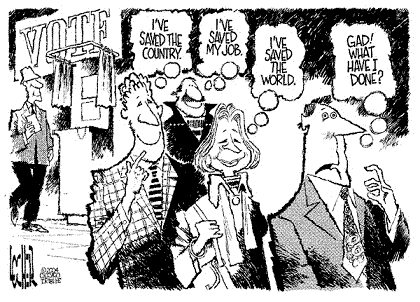
What Makes A Fair Election?


In a democracy we always say, majority rules. But, what exactly is a majority?

The simplest type of voting involves only two choices. With two choices, the most common way of deciding is majority rule, that is, the candidate with more than 50% of the vote wins. While this rule is taken for granted, it is important to check three properties:

1. Every vote has the same weight.

2. There is symmetry between the candidates. If all votes were reversed, the loser would become the winner.

3. If a vote for the loser were changed to a vote for the winner, the outcome of the election will not be changed.

Of course, in a democracy, there are many variations of this majority rule. A Constitutional Amendment can only be passed if it is approved by 2/3 of Congress and 3/4 of the states. A jury can only convict on criminal charges if there is 100% agreement.

Voting with more than two choices is much more complex. Sometimes, more often than not, no one gets a majority. Mo gets 35% of the votes, Larry gets 33% of the votes and Curly gets 32% of the votes. Mo cleary has the most votes, but not a majority. He has what is known as a plurality. These votes are very close. If Larry had decided to drop out and all his supporters decided to vote for Curly, Curly would win. Problems are definitely going to arise in this system. Studying this, makes it clear as to why some of our presidential hopefuls are dropping out early and giving their support to others.

In the mathematics of voting, we study different ways of holding an election, using preference schedules. We hold elections using run-offs of the top two candidates, sequential run-offs (similar to American Idol), Borda Counts (similar to figuring out GPAs) and pairwise comparisons. Holding the same election each way can give different results.

One of the things we always want is fairness. Judging fairness is subjective but mathematicians and political scientists have come up with four basic fairness criteria that must be met by a fair voting system.

Criterion 1: If a candidate recieves a majority of the first-place votes, that candidate should be the winner.
Criterion 2: If a candidate is favored over every other candidate in pairwise races, that candidate should be declared the winner.
Criterion 3: If a candidate is declared a winner and a second election is held which ranks the candidate higher, that candidate will still be the winner.
Criterion 4: If a candidate is declared a winner and a second election is held in which one of the losing candidates drops out, then that candidate should still be the winner.

In 1973 Kenneth Arrow received the Nobel Prize in Economics for his mathematical analysis of voting systems that led him to discover that no voting system satisfies all four fairness criteria.

I've only touched on this topic here, but it is one that I enjoy teaching. Delving further into it, students can appreciate how the electoral system we have now was developed. It brings real life applications of mathematics into my student's lives. It shows them that there is more to mathematics than the quadratic formula. There is a strong correlation to what they are learning in their government and in their math classes. For my weaker students, it is a way to practice arithmetic and calculator skills in an interesting manner. Kids who can't do the basics, are still drilling their basics (percents, fractions, decimals) and are not being treated like babies.

Source: Using and Understanding Mathematics by Jeffrey Bennett and William Briggs.